Why the visible stain is not the limit
Gypsum and its paper facing pull water upward. After a few hours of standing water, moisture can climb well above the mark the flood left, and the insulation behind the wall soaks up even more. Fiberglass batts sag and hold water against the framing; cellulose and some foam products behave differently but still need to be checked. If the cut is made just above the stain, the remaining drywall may still be wet and contaminated along its bottom edge.
The usual approach is to measure moisture with a meter above the water line, find where readings return to normal, and set the cut somewhat higher than that. Many cleanups land on standard heights that make the rebuild easier, because new drywall is installed in sheets and a cut aligned with a sheet width or half-sheet saves patching. That is a reasonable practical choice, but the height should still be justified by readings rather than habit.
Walls in a walkout or garden-level space often have more going on than a typical interior partition: exterior walls with insulation and vapor retarders, plumbing for a wet bar, and electrical outlets set at standard height. Outlets and wiring that were submerged need an electrician's evaluation, which sometimes pushes the cut higher to give access.
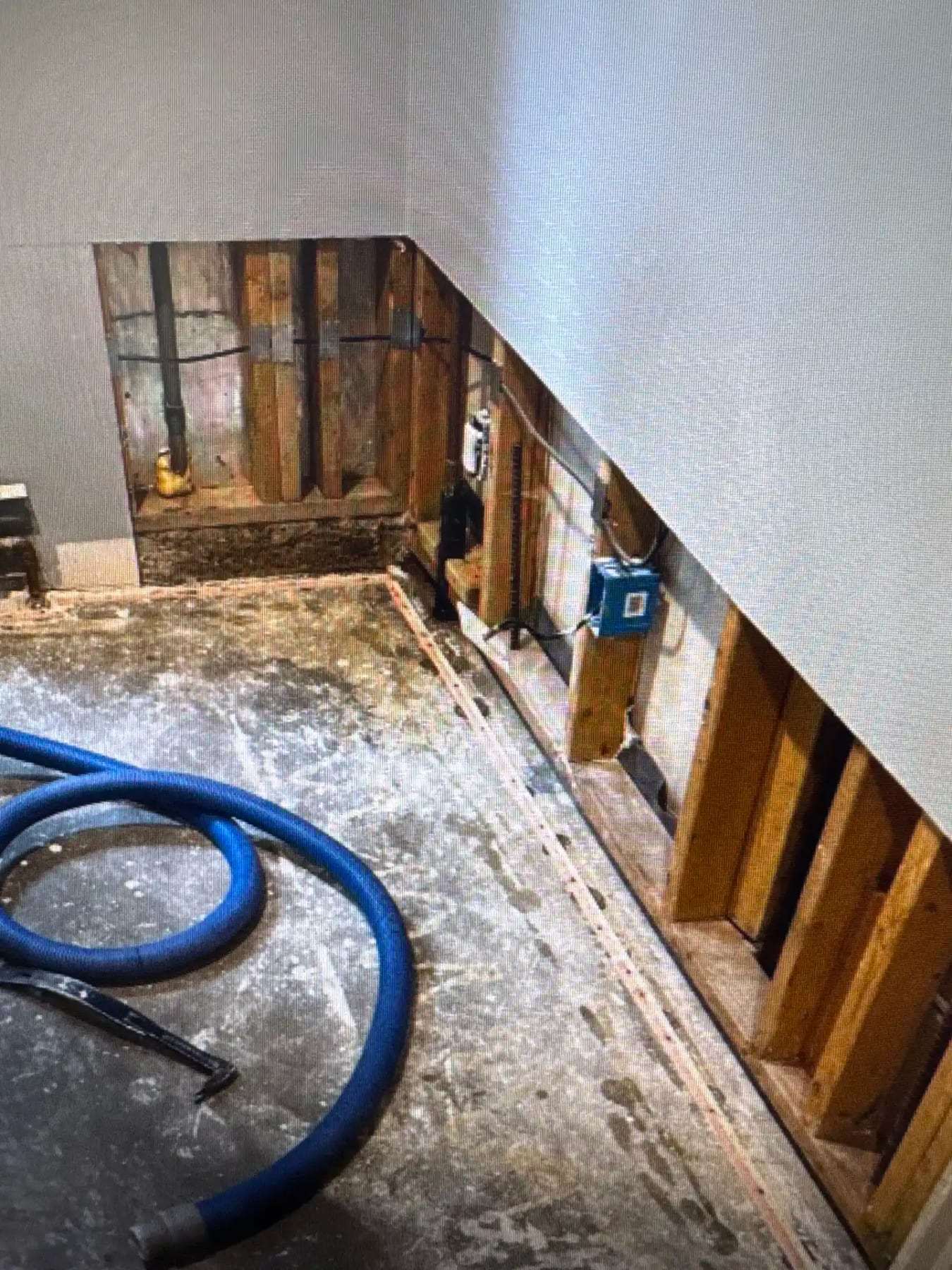
Bathroom demolished to the framing with drying hoses on the floor. Illustrative only: this photo is not from a job tied to this site or a specific address.
Factors that push a cut higher or lower
- Factor
- How long water stood
- Tends to raise the cut
- Many hours or overnight
- Tends to keep it lower
- Water out within a short time
- Factor
- Insulation type
- Tends to raise the cut
- Fiberglass batts that soaked and sagged
- Tends to keep it lower
- Uninsulated interior partitions
- Factor
- Moisture readings
- Tends to raise the cut
- Elevated readings well above the stain
- Tends to keep it lower
- Readings normal just above the stain
- Factor
- Wall contents
- Tends to raise the cut
- Submerged outlets or plumbing needing access
- Tends to keep it lower
- No services in the lower wall
- Factor
- Wall finish
- Tends to raise the cut
- Paneling or wallpaper hiding wet drywall
- Tends to keep it lower
- Painted drywall that can be read with a meter
- Factor
- Rebuild layout
- Tends to raise the cut
- Sheet widths that make a taller cut cleaner
- Tends to keep it lower
- Wainscot or trim that can hide a lower seam
Quick decision points on a flooded wall
- IfThe wall is an exterior basement wall with soaked insulationExpect the cut to go at least as high as the wet insulation, and confirm what sits behind it before closing up.
- IfReadings drop to normal a short distance above the stainA cut a little above that point, at a convenient rebuild height, is usually enough.
- IfReadings stay elevated well up the wallAsk whether water is also coming from somewhere else, such as a window well or roof leak, before cutting higher.
- IfThe wall has wood paneling over drywallPaneling hides moisture; expect both layers to be removed in the affected area.
- IfOutlets were under waterLeave the circuit off and have an electrician inspect before power is restored.
General information for Castle Rock, not a quote or professional advice. In an emergency, call 911.